The Relational Age: How Ambient Intelligence Completes the Information Era and Begins the Reweaving of Human Connection
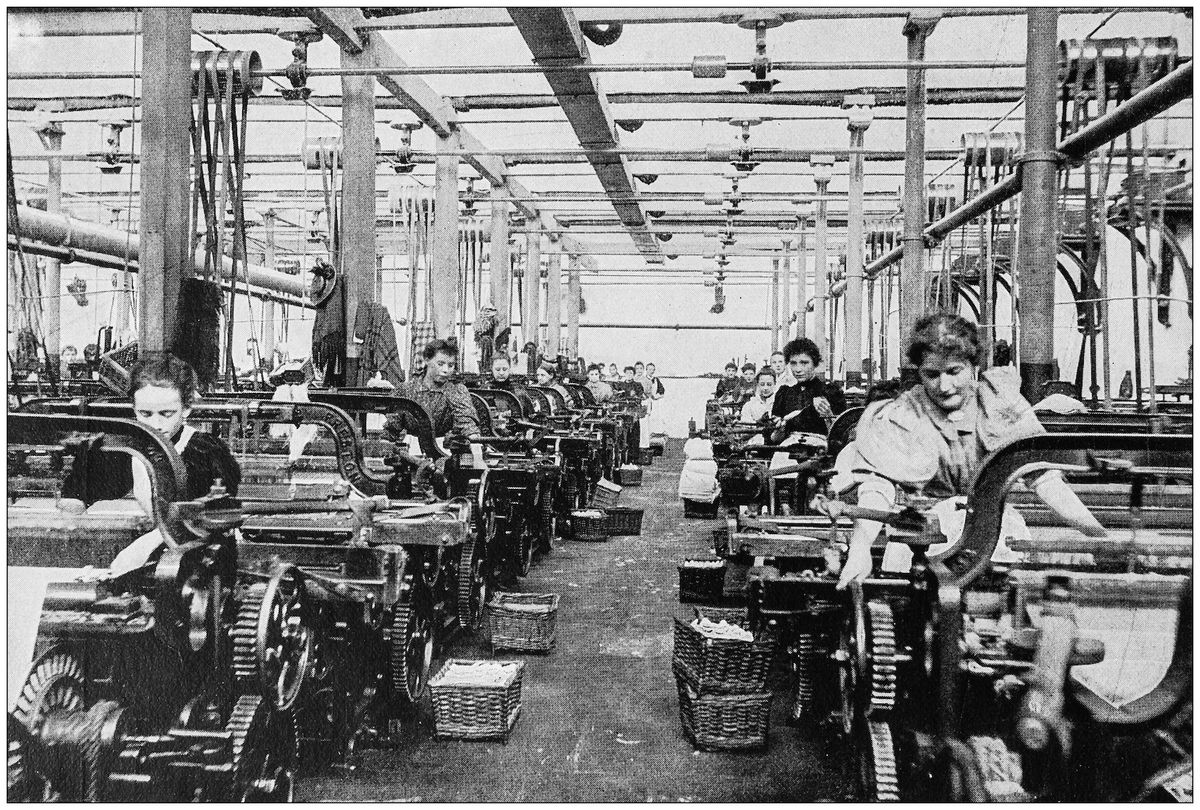
Antique photograph of a Lancashire cotton mill. Getty Images; via HowStuffWorks (Industrial Revolution factory system).
The Industrial Age did not end when the last steam engine was built or when factories covered the landscape. It ended—quietly, pervasively—when industrial capabilities became the invisible background of everyday life. Electricity, internal combustion, mechanized production, and global logistics stopped being "the new technology" and simply became the water we swam in. What had once required conscious attention and wonder became infrastructure. Only then did a new set of questions rise to the surface: not "how do we make more things faster?" but "what kind of societies, cities, and daily rhythms do we actually want to live inside the world we have built?"
We are standing at the equivalent threshold for the Information Age.
The Information Age: Abundance, Fracture, and the Limits of "More"
The Information Age delivered on its core promise. Knowledge, once locked in libraries and institutions, became searchable and shareable at global scale. Computation and networks compressed time and distance. AI, in its current explosive phase, represents the logical culmination of that trajectory: intelligence itself—pattern recognition, language, planning, creation—becoming abundant and on-demand.
Yet the very success of the era exposed its boundaries. Social platforms connected humanity while simultaneously fragmenting shared reality and deepening loneliness. Algorithmic optimization of attention produced economic value but often at the cost of individual agency and collective sensemaking. Institutions designed for scarcity struggled to adapt to informational abundance. The result has been visible rifts in the social fabric: eroded trust, polarized discourse, weakened local communities, and a widespread feeling that more data, more connection, and more processing power have not automatically produced more meaning or coherence.
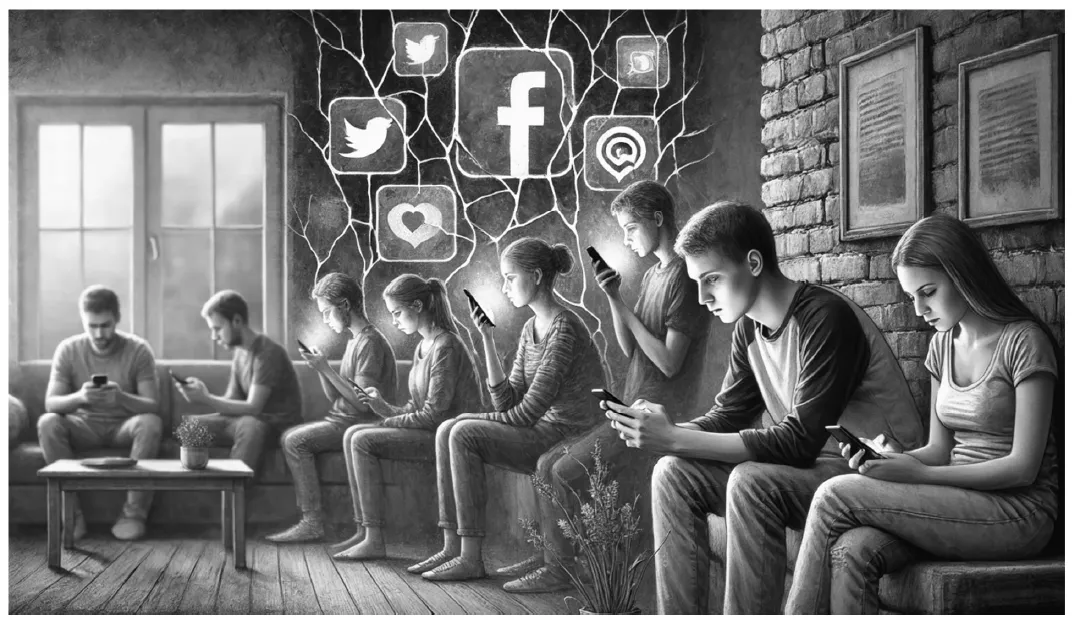
Figure illustrating “phubbing” and disconnection in the digital age (DALL·E). From The Reconfiguration of Social Bonds in the Digital Age (Silva, Nature & Anthropology, SCIEPublish, 2025); image source.
These are not failures of the Information Age; they are its natural endpoints. An era defined by the production, distribution, and consumption of information eventually reaches a point where the bottleneck is no longer access to information but the human capacity to relate to one another—and to ourselves—inside that flood.
Ambient Intelligence: The Quiet End of the Distinct "AI Era"
The next decisive shift is already underway. As AI systems become more capable, multimodal, agentic, and embedded, we are moving toward ambient intelligence—intelligence that is context-aware, anticipatory, and woven into the fabric of environments, objects, and interactions rather than something we deliberately "use" like a search bar or chatbot.
Think of it as the difference between the early personal computer (a distinct object on a desk that demanded your attention) and electricity (present in every wall, invisible until it fails). When AI reaches this state—always on, quietly helpful, fading into the background of daily life—the dramatic, headline-grabbing phase of "the AI revolution" will be over. The technology will be ever-present infrastructure. At that point, the Information Age, as a distinct historical period, will have fulfilled its arc and receded.
What rises in its place is not another technology-centric label, but a fundamentally human one: the Relational Age.
The Relational Age: From Information Abundance to Relational Quality
In the Relational Age, the scarce and valuable resource is no longer information or raw computational power. It is the quality of relationships, the coherence of communities, the intentionality of gatherings, and the design of organizational principles that treat humans as relational beings rather than isolated nodes or mere consumers of content.
This shift mirrors the Industrial precedent in reverse. The Industrial Age forced us to reorganize around machines and energy flows; the Relational Age invites us to reorganize around human connection and coordination, now supported by ambient intelligence rather than constrained by informational scarcity.

AI-augmented smart home management system (Adobe Stock). Image source (Irish Tech News).

New forms of community and gathering are already emerging as prototypes:
- Intentional hybrid spaces where physical presence is augmented by AI that helps surface shared context, translate across perspectives, or synthesize collective input in real time.
- Fluid "purpose guilds" and project-based networks that form, collaborate, and dissolve without the overhead of traditional institutions.
- Local and regional coordination systems that treat care, learning, resource sharing, and decision-making as relational processes rather than purely transactional or hierarchical ones.
Organizational principles are evolving alongside them. We are beginning to see experiments in governance that move beyond 18th- and 19th-century models of individual rights and linear authority toward frameworks that account for distributed agency, feedback loops, ecological interdependence, and the reality that humans (and increasingly human-AI ensembles) act within complex, overlapping systems.
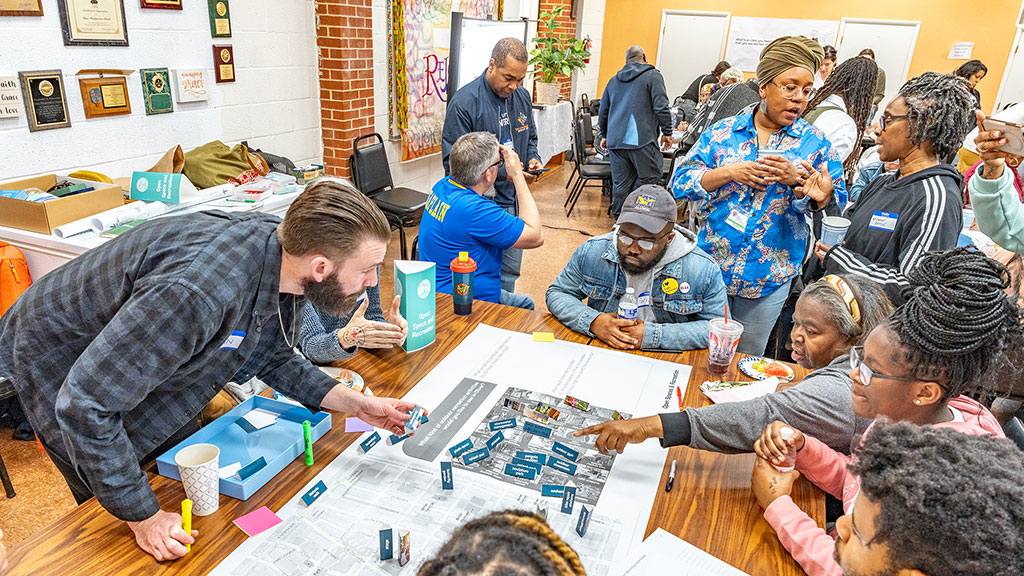
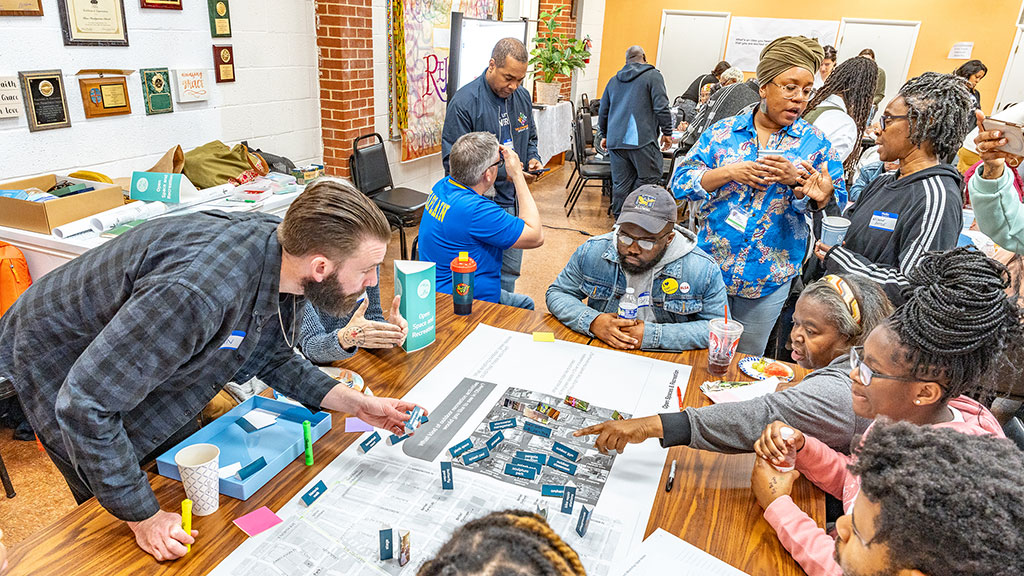
Community engagement session, Baltimore. Photo by Ras Tre Subira; from Equitable Public Engagement for a Changing World (Gensler, 2024); image source.
The Opportunity and the Work Ahead
None of this is automatic or guaranteed to be benign. Ambient intelligence can be designed to amplify human agency, deepen relationships, and support regenerative coordination—or it can be designed to optimize extraction, subtle behavioral control, and new forms of fragmentation. The rifts of the late Information Age are not automatically healed by more sophisticated technology; they are invitations to make different choices about what we build and how we live inside it.
The Industrial Age ultimately made possible material abundance that earlier generations could barely imagine. The Relational Age holds the parallel promise: forms of belonging, collective intelligence, and coordinated flourishing that feel as natural and indispensable, a century from now, as electricity and running water feel to us today.
We are not merely observers of this transition. The choices we make while ambient intelligence is still visibly emerging—about design priorities, governance experiments, community prototypes, and the stories we tell about what intelligence is for—will determine whether the Relational Age becomes a period of reweaving and renewal or simply another layer of managed disconnection.
The Information Age gave us the tools. Ambient intelligence will give us the invisible substrate. What we do with both is the work of the Relational Age.
The factories are no longer the frontier. The data centers, in their current spotlight form, will not remain the frontier for long. The frontier is now the quality of the webs we choose to weave between one another—and with the intelligence we have brought into being.