Reviving Dialogue in the Time of AI (The Vatican)
The Pope and the Vatican say we must revive dialogue in this time of AI.
In Magnifica Humanitas — Pope Leo XIV's encyclical on safeguarding the human person in the time of artificial intelligence — one of the document's culminating calls is exactly that: to move from a culture of power to a culture of negotiation, diplomacy, and encounter. Nothing is lost with peace; with war, everything can be lost.
Links
The arc of the document
The encyclical's complete arc:
Introduction: Humanity faces a choice between Babel and Jerusalem.
Chapter One: Social Doctrine is dynamic; AI is one of the res novae — the "new things" — that must be discerned.
Chapter Two: The principles of dignity, common good, solidarity, subsidiarity, social justice, and universal destination of goods provide the moral grammar.
Chapter Three: AI and technological power threaten to reduce humanity through the technocratic paradigm, false transcendence, and domination.
Chapter Four: These threats become concrete in truth, education, work, economics, freedom, addiction, surveillance, and hidden exploitation.
Chapter Five: The highest-stakes arena is war, where AI can intensify the culture of power unless subordinated to peace, diplomacy, and the civilization of love.
Conclusion: Christians and all people of goodwill must become wise architects of a humane future: faithful to truth, invested in education, rooted in relationship, committed to justice, and guided by the perspective of the lowly.
The deepest claim
AI is not merely a technological revolution. It is an anthropological, spiritual, political, and civilizational test.
It asks whether humanity will use intelligence to dominate reality, optimize people, monetize weakness, automate violence, and build Babel — or whether humanity will use technology as one tool within a larger project of communion, justice, peace, and love.
In the language of the document:
The task is to remain human in an age that can easily mistake power for progress.
Reviving dialogue
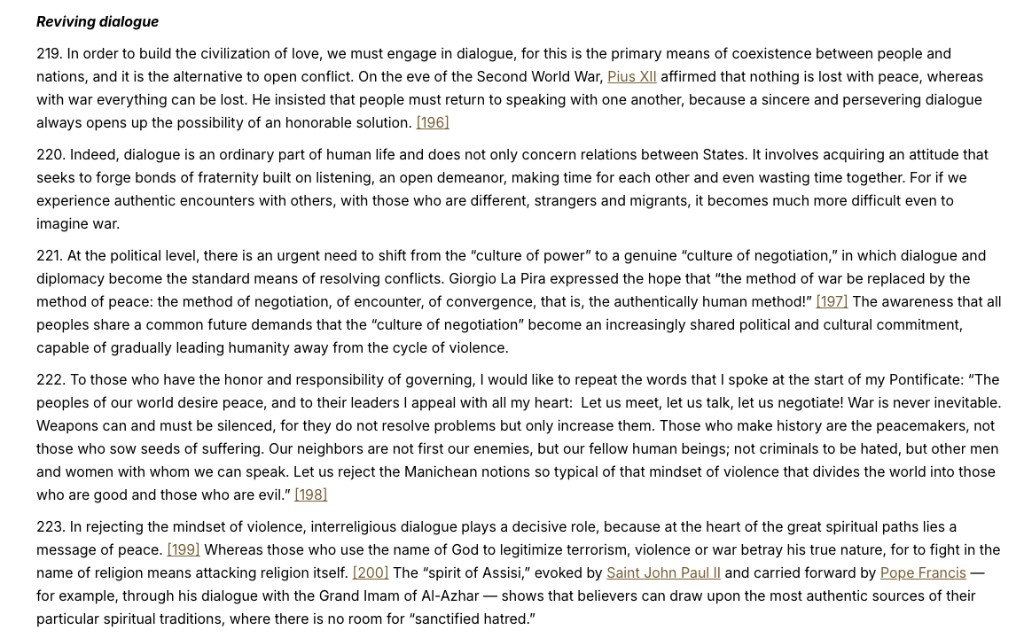
The encyclical's section on Reviving dialogue makes the stakes plain. Dialogue is not a soft alternative to conflict; it is the primary path toward a civilization of love. It forges bonds of fraternity through listening and time spent together — making it harder to imagine war.
The document calls leaders to reject Manichean divisions that treat neighbors as enemies rather than fellow human beings. It points to interreligious dialogue and the "spirit of Assisi" as proof that authentic spiritual traditions have no room for sanctified hatred.
For Dialogues, this resonates directly. If every model defines a game, then the question is not only what game are we playing? but whether we still have an arena in which beliefs, values, and consequences can be negotiated — between people, and between people and the systems we build.
Reviving dialogue in the time of AI means refusing to let optimization replace encounter, or power replace persuasion. It means keeping room for the human subject — for relationship, for dissent, for the slow work of understanding — inside every system that claims to think on our behalf.
That is the test. That is the work.